
By Cap City Injury Attorneys13 min read
Amazon Delivery Accident Lawyer Austin: Liability
An amazon delivery accident lawyer austin can explain driver and DSP liability, insurance, evidence to preserve, and Texas deadlines after a crash.
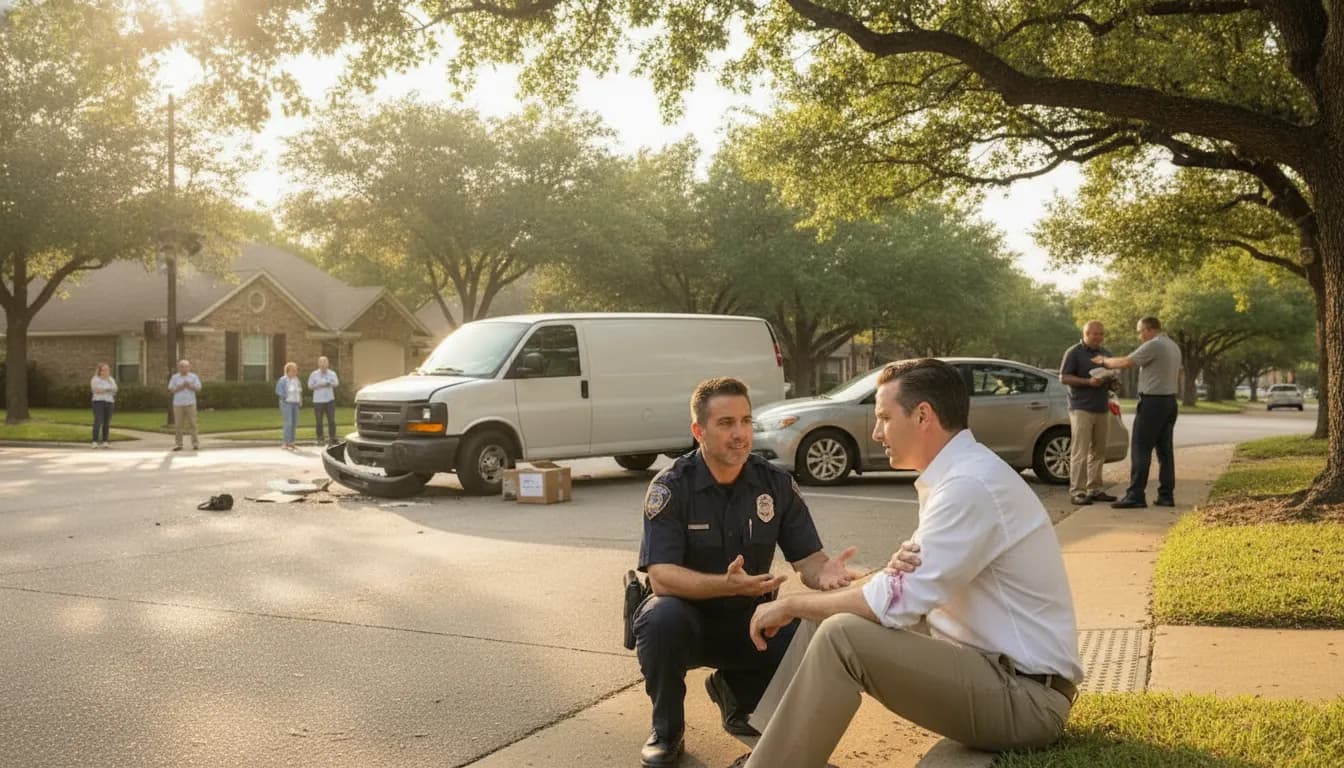
A crash involving an Amazon-branded van can leave an injured Austin driver unsure who should answer for the damage. The logo on the vehicle does not, by itself, establish who employed the driver, controlled the route, owned the van, or carried the applicable insurance.
If you are searching for an amazon delivery accident lawyer austin, know that the vehicle logo does not identify the responsible party. Potential responsibility may involve the driver, a Delivery Service Partner, Amazon, a vehicle owner, or another party. The work relationship, driver's conduct, and available evidence all matter.
Contact Cap City Injury Attorneys to discuss your delivery-vehicle collision.
The first question is how the driver was working at the time of the crash and what the evidence shows about each participant's role. That analysis can determine whether liability rests with one party or is divided among several.
Who Is Liable When an Amazon Delivery Driver Causes an Accident?
Responsibility after an Amazon delivery crash is not determined by the logo on the vehicle alone. The investigation may need to identify the driver's work status, who controlled the delivery route and vehicle, and what the driver was doing when the collision occurred. A driver making assigned deliveries may raise questions about employer or contractor responsibility. If the driver was using the vehicle for personal, off-duty purposes, the driver may be a more direct defendant. The facts and available evidence control.
An employer may sometimes be responsible for an employee's conduct when the employee was acting within the scope of employment. That does not mean Amazon or a Delivery Service Partner, or DSP, is automatically liable in every crash. A DSP may be a separate business, and the relationship between the DSP, Amazon, and the driver must be examined rather than assumed. Contractor labels alone may not resolve the issue. Courts can consider practical details such as control over the driver's schedule, route, and equipment.
Other potentially responsible parties may include the company that owns or leases the delivery vehicle, a maintenance provider, or a company that loaded cargo improperly. A defective vehicle component could also raise a claim involving a manufacturer. These possibilities are fact-dependent, and more than one person or business may share responsibility. Commercial-vehicle liability can extend beyond the driver to employers, maintenance providers, cargo loaders, or manufacturers when the evidence supports those claims. The same driver-versus-company questions can arise in other Texas delivery crashes, but each collision should be evaluated on its own facts.
Texas uses proportionate-responsibility rules in covered tort cases. The factfinder may assign percentages to the claimant, defendants, settling persons, and properly designated responsible third parties. A claimant whose responsibility is greater than 50 percent may not recover damages under the applicable statute. See Texas Civil Practice and Remedies Code Chapter 33 for the statutory framework.
For an Austin or Central Texas collision, preserving vehicle records, delivery information, photographs, witness accounts, and medical documentation can help clarify which parties may be involved. Readers can also review this specialty injury claims guide for related Texas personal-injury issues.
What Is a Delivery Service Partner (DSP) and Why Does It Matter for Your Claim?
A Delivery Service Partner, or DSP, is a business that may provide delivery services through a contractor relationship. The label alone does not answer who is legally responsible after a crash. An investigation must examine how the work was actually organized and who had meaningful control over the delivery operation.
For example, evidence about the schedule, assigned route, vehicle, equipment, dispatch process, and supervision may help show how the driver and company operated. Courts may consider actual control over these details rather than relying only on the language used in a contract. That does not mean a particular company is automatically responsible. It means the working relationship deserves a fact-specific review.
What investigators examine
Important questions can include who hired or directed the driver, who owned or leased the vehicle, who assigned deliveries, and who maintained the van or truck. Investigators may also examine training, inspection records, communications, delivery logs, and whether the driver was performing assigned work when the collision occurred. The driver may have personal responsibility for negligent conduct. While a company or other party may have separate responsibility based on its own conduct or relationship with the driver.
Maintenance can create another line of inquiry. If a mechanical problem contributed to the crash, a maintenance contractor or another responsible business may need to be identified. In some cases, responsibility may be divided among the driver, delivery company, vehicle owner, and maintenance provider. Texas law allows responsibility to be assessed among multiple parties in appropriate tort cases, but the allocation depends on the evidence and legal issues in that claim.
Preserving vehicle information, witness accounts, photographs, medical records, and delivery-related records can help clarify these relationships. An Austin injury investigation should focus on what each party did, controlled, or failed to do, rather than assuming liability from the Amazon branding on the vehicle.
Does Amazon's Insurance Cover Accidents Caused by Their Contractors?
There may be insurance available after a collision involving an Amazon-branded vehicle, but the branding alone does not identify the policy that applies. Coverage must be investigated through the specific driver, vehicle owner, delivery company, policy documents, and facts of the crash. A claim may involve more than one potential source of insurance, or a dispute about whether a policy covers the particular trip.
Policies that may need to be investigated
The driver's personal auto policy may be relevant, although personal policies can contain conditions or exclusions for delivery work. If the driver worked for a Delivery Service Partner, the DSP's commercial auto policy may also need to be identified and reviewed. The company that owned, leased, maintained, or controlled the vehicle could have a separate role in the coverage investigation.
Amazon Flex or another platform-related arrangement may raise different questions from a DSP delivery. Investigators may need to determine whether the driver was logged into the platform. Actively making a delivery, traveling to a pickup, or using the vehicle for a personal purpose. The applicable policy language, current program terms, and timing of the crash matter. Public descriptions of a delivery program do not prove that a particular policy covers your injuries.
Do not overlook your own coverage
Your own auto policy may provide uninsured or underinsured motorist coverage, depending on its terms and the facts. That coverage is not an automatic benefit simply because the other vehicle was connected to Amazon. It may become important if the responsible driver or company lacks applicable insurance, disputes responsibility, or has coverage that does not fully address the losses.
Before accepting an insurer's position, preserve the crash report, driver and vehicle information, delivery details, photographs, medical records, and communications. A careful review can help identify which parties and policies should be notified without assuming that Amazon, a DSP, or an insurer is automatically responsible.
How Is Delivery Driver Liability Different From Commercial Trucking Liability?
A crash involving a delivery van or box truck can look different from a collision involving an 18-wheeler, but both vehicles are commercial vehicles. Amazon, FedEx, UPS, and local courier vans may carry packages rather than freight over long distances, yet their use for business can create additional questions about responsibility.
In a typical last-mile delivery case, the investigation may focus closely on the driver's conduct, delivery schedule, route, phone use, fatigue, and training. It may also be necessary to determine whether the driver worked for the delivery company directly. Operated as a delivery service partner, or used a personal vehicle for delivery work. The company's ownership or control of the vehicle can matter as well.
Commercial trucking cases can involve those same issues, along with evidence that is more common in larger trucking operations. Such as driver qualification records, dispatch records, electronic data, and hours-of-service compliance. The size of the vehicle does not decide the legal issues. A delivery van or box truck may still require investigation into maintenance, loading practices, vehicle ownership, and whether a defective part or manufacturing problem contributed to the crash. Potential responsibility may extend beyond the driver to an employer, maintenance provider, cargo loader, or manufacturer, depending on the evidence.
| Crash setting | Questions to investigate | Records that may matter |
|---|---|---|
| Last-mile delivery | Driver status, route, dispatch, vehicle control, and delivery activity | Delivery logs, messages, camera footage, and vehicle data |
| Larger commercial trucking | Driver qualifications, maintenance, loading, and operating compliance | Inspection files, dispatch records, electronic data, and maintenance records |
These distinctions can affect which records should be preserved and which parties should receive notice of a claim. A careful investigation should identify the driver, employer or delivery service partner, vehicle owner, maintenance providers, and any other potentially involved businesses before conclusions are reached. For more on investigating a larger commercial-vehicle collision, review these Austin truck accident claims.
What Evidence Should You Preserve After a Delivery Vehicle Accident?
After a delivery vehicle crash in Austin, evidence can disappear quickly. Preserve what you safely can, and do not delay emergency care to document the scene.
- Get medical help and involve police. Call 911 when anyone may be injured, request medical evaluation, and follow the care instructions you receive. Texas Transportation Code Section 550.021 requires a driver in a collision that results, or is reasonably likely to result. In injury or death to stop, determine whether anyone needs aid, and remain at the scene while completing the statutory requirements. Read the current statute at Texas Transportation Code Section 550.021.
- Photograph and record the scene. From a safe position, capture vehicle damage, the delivery vehicle's identifying information, road conditions, traffic controls, debris, visible injuries, and the surrounding area. Note the exact location, date, and approximate time. If video is available, preserve the original file rather than relying only on a social-media upload.
- Identify witnesses. Ask witnesses for names and contact information. Write down what you remember while the sequence of events is fresh, including weather, lighting, traffic, and any contributing conditions.
- Keep medical and financial records. Save medical records, discharge instructions, prescriptions, bills, mileage, wage-loss records, and notes about symptoms or limitations. Continue reasonably prescribed care and avoid activities that could worsen an injury.
- Document property damage. Keep repair estimates, towing and storage invoices, photographs taken before repairs, and information about damaged personal property. Do not discard or repair a vehicle in a way that prevents inspection without considering how the condition will be documented.
- Preserve communications and request vehicle data. Keep texts, emails, claim letters, adjuster contact information, and delivery-company communications. Avoid giving a recorded insurer statement or signing a settlement before understanding what it covers. Promptly request preservation of driver, vehicle, dispatch, route, camera, telematics, maintenance, and delivery records. More practical delivery truck crash evidence guidance may help you organize that request.
How an Amazon Delivery Accident Lawyer in Austin Reviews Texas Deadlines
Texas generally gives an injured person two years after a personal-injury cause of action accrues to bring a lawsuit. That rule appears in Section 16.003 of the Texas Civil Practice and Remedies Code. The important detail is that the period runs from accrual, which may not always be analyzed as simply as counting two years from the day of a crash. The specific claim, parties, and facts can affect that analysis.
Two years is a general rule, not a guarantee that applies to every Amazon delivery accident. It is also different from an insurance notice or claim deadline. An insurer, contractor, or other company may request prompt notice, records, or a statement under its claims process. Missing that type of deadline can create practical problems even when the statute of limitations has not expired. Those requirements should be identified and evaluated for the specific claim.
Texas law also addresses qualifying legal disabilities. If a person is under a legal disability when a personal-injury cause of action accrues, the period of that disability may not be included in the limitations period. For this subchapter, legal disability includes being younger than 18 or of unsound mind. These provisions are fact-specific and should not be assumed to extend a deadline in every situation. See Texas Civil Practice and Remedies Code Section 16.003.
Do not wait until the deadline is close. Delivery-vehicle evidence can become harder to locate, including driver records, vehicle data, route information, surveillance video, witness accounts, and medical documentation. Preserve what you can, seek appropriate medical care, and have the deadline and notice requirements reviewed promptly.
Frequently Asked Questions
Can I sue Amazon if an Amazon delivery driver injured me in a crash?
Possibly, but Amazon is not automatically responsible because its name appears on the vehicle or delivery materials. The claim may involve the driver, a Delivery Service Partner, Amazon, the vehicle owner. Or another company, depending on the driver's work relationship, assigned duties, control, and the evidence. An investigation can help identify the proper parties and the facts supporting each potential claim.
Are Amazon delivery drivers employees or independent contractors?
They may work in different arrangements, including for a Delivery Service Partner or as an Amazon Flex driver. A contractor label does not by itself resolve liability. The investigation may examine who controlled the driver's schedule, route, equipment, and delivery duties, along with who owned or maintained the vehicle.
Does Amazon cover accidents caused by its contractors?
Coverage depends on the specific driver, vehicle, business relationship, policy, and circumstances of the collision. Do not assume that Amazon's commercial insurance, a DSP policy, a personal auto policy. Or uninsured or underinsured motorist coverage applies without verifying the policy terms and claim facts. Request and preserve insurance information, but avoid giving a recorded statement or signing a release before understanding what is being offered.
What evidence should I gather after an Amazon delivery accident?
Preserve photos and video, the delivery vehicle's identifying information, the location and time, witness details. The crash report, medical records, bills, property-damage records, and communications with Amazon, the driver, or an insurer. Texas law requires a driver in a collision resulting or likely to result in injury to stop and determine whether aid is needed. See Texas Transportation Code Section 550.021.
How long do I have to file a lawsuit after an Amazon delivery accident in Texas?
Texas generally requires a personal-injury lawsuit to be filed within two years after the claim accrues, under Texas Civil Practice and Remedies Code Section 16.003. Exceptions and different notice requirements may apply, including rules involving certain legal disabilities. Prompt legal review is important because identifying the right defendant and preserving delivery, vehicle, and insurance evidence can take time. See Texas Civil Practice and Remedies Code Section 16.003.
Ready to Discuss Your Amazon Delivery Accident?
Responsibility after an Austin delivery crash can depend on the driver's work relationship, insurance coverage, and the evidence available. A focused review may help you understand which parties and next steps deserve attention. Contact Cap City Injury Attorneys through the online contact form to discuss your accident and potential next steps.
More on the blog
Keep reading.
14 min read
Traumatic Brain Injury Lawyer Austin: Costs and Options
Traumatic brain injury lawyer Austin guidance on TBI documentation, long-term costs, Texas damages, insurance questions, and legal options for injured families.
By Cap City Injury Attorneys
14 min read
Dog Bite Lawyer Austin: Texas Claim Guide
Dog bite lawyer Austin guidance on Texas liability, evidence, damages, immediate steps, and the filing deadline after an attack. Learn what to document.
By Cap City Injury Attorneys
Let's talk about your case.
Free case review, no obligation. We'll tell you straight whether we can help.