
Pedestrian & bicycle accidents · Subcategory
Crosswalk Accident Claims
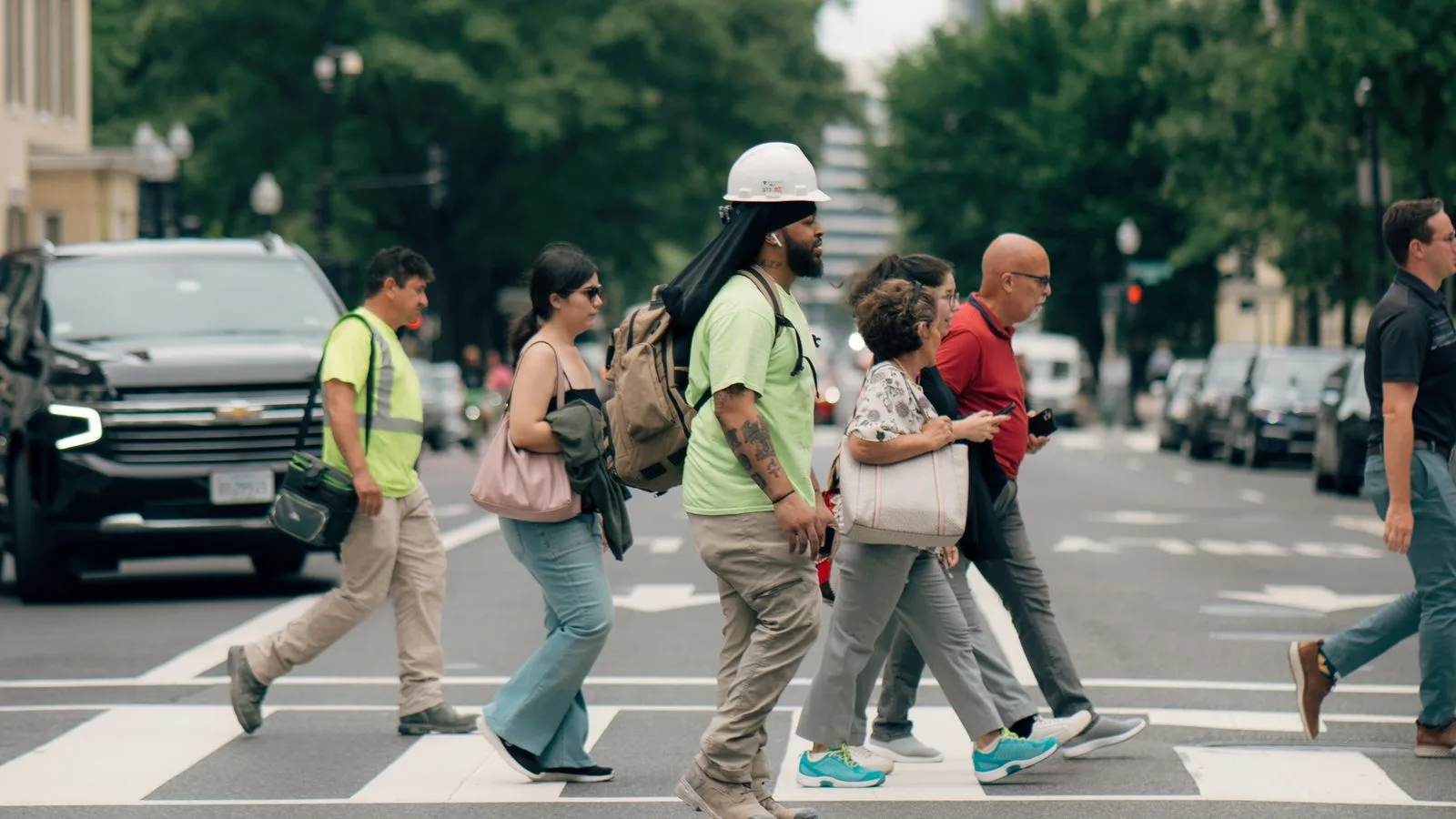
A crosswalk accident claim is a pedestrian-injury case where the strike occurred within a marked or unmarked crosswalk under Texas law. The defining legal question is whether the pedestrian was within the crosswalk lines, which Tex. Transp. Code § 541.302(2) defines to include unmarked crosswalks at every intersection: the portion of the roadway within the lateral connections of sidewalk lines on opposite sides. When the pedestrian was within the crosswalk on a permitted phase, the driver's duty to yield under § 552.003 is a near-conclusive liability point, and the case work shifts to damages and coverage rather than fault.
Marked versus unmarked crosswalks, and why the distinction matters less than people think
Texans often assume a crosswalk requires painted lines. The statute is broader. Every intersection has an unmarked crosswalk on each leg of the intersection, defined by extending the sidewalk lines across the roadway. A pedestrian crossing within those implied lines at an intersection is in a crosswalk for purposes of § 552.003, even though no markings exist. Marked crosswalks make the evidentiary case simpler: the lines are visible in photos and footage, but unmarked crosswalk cases are equally winnable when scene measurements and photographs document the pedestrian's position. The defense often pushes the 'no crosswalk' framing in early offers; the statute defeats it.
Intersection versus mid-block crossings
Crosswalk rights and duties operate differently at intersections than at mid-block crossings. At an intersection, every leg has either a marked or unmarked crosswalk and the § 552.003 yield duty attaches. At a mid-block location, a crosswalk exists only if marked; there is no implied mid-block crosswalk under Texas law. Mid-block crossings outside a marked crosswalk fall under § 552.005, which requires the pedestrian to yield the right-of-way to vehicles. But the driver still owes the duty of due care under § 552.008, and a driver who strikes a mid-block pedestrian in clear visibility at moderate speed has not satisfied that duty regardless of crosswalk status. The location of the strike sets the starting allocation, not the ending one.
Signal timing as the central evidentiary question
At signalized intersections the case typically rises or falls on the signal phase at the moment of the strike. The pedestrian-phase signal in Austin runs through three states: solid walking-person ('Walk'), flashing upraised-hand ('Don't Start'), and solid upraised-hand ('Don't Walk'). A pedestrian who entered the crosswalk on a fresh walking-person symbol has the right-of-way, even if the signal changes mid-crossing, until the crossing is complete. The City of Austin Transportation Department retains signal-timing data that can be obtained by request, and the timing data combined with pole-mounted camera footage typically resolves the signal-phase question definitively. We pull both within the first week.
Driver lookout and the right-turn-on-red problem
A significant share of crosswalk strikes involve drivers making a right turn on red who looked left for a gap in cross-traffic and never looked right toward the crosswalk. Tex. Transp. Code § 544.007 permits a right turn on red after stopping but does not abrogate the duty to yield to pedestrians lawfully in the crosswalk under § 552.003. The same fact pattern recurs across Austin's downtown grid: a driver looks left, sees the gap, accelerates, and strikes a pedestrian crossing from the driver's right with the walking-person signal. The lookout failure is the breach; the right-on-red statute does not provide cover for it. We document the maneuver from camera footage where available and from independent witnesses who were waiting at adjacent corners.




Frequently asked
Questions Texas accident victims ask us
- Effectively yes. Tex. Transp. Code § 541.302(2) defines a crosswalk to include the portion of the roadway at an intersection within the connections of the lateral lines of the sidewalks on opposite sides, whether or not marked. Every intersection therefore has crosswalks on each leg, even when no paint is on the pavement. The driver's duty to yield to pedestrians under § 552.003 applies in both marked and unmarked crosswalks.
- You retain the right-of-way to complete the crossing. The pedestrian-phase signal sequence, walking-person to flashing upraised-hand to solid upraised-hand, anticipates that pedestrians who began on the walking-person symbol may still be in the crosswalk when the signal advances. Drivers must yield to pedestrians lawfully in the crosswalk regardless of which signal phase is currently displayed. A driver who proceeds into a pedestrian completing a lawfully begun crossing has breached the yield duty.
- Often yes, though comparative fault is more squarely in play. Outside a marked crosswalk and outside an intersection, the pedestrian must yield the right-of-way to vehicles under Tex. Transp. Code § 552.005. But the driver retains the duty of due care under § 552.008. A driver who had a clear view, time and distance to react, and nonetheless struck a mid-block pedestrian has not satisfied the due-care duty. Cases turn on speed, lighting, the pedestrian's visibility, distraction evidence against the driver, and the closing-distance math.
- Two evidentiary sources, used together. The Austin Transportation Department retains signal-timing data for city-managed signals; the data records the cycle and phase timing for each leg of the intersection. Pole-mounted intersection cameras (city signal cabinets) capture the actual movement and timing at the scene. Footage from nearby business cameras frequently confirms the pedestrian signal as well as the driver's phase. We pull all three within the first week, before any of the footage overwrites.
- Tex. Transp. Code § 544.007 permits a right turn on red after a complete stop and after yielding to pedestrians and cross-traffic. The yield duty to pedestrians is the controlling point: a driver completing a right turn on red who fails to look right toward the crosswalk before accelerating into the turn has not yielded. The right-on-red statute does not displace the yield duty under § 552.003; it adds the stop requirement on top of the existing pedestrian-yield obligation.
- No. The crosswalk-specific yield duty under § 552.003 applies inside a crosswalk; the general due-care duty under § 552.008 applies everywhere. A pedestrian struck outside a crosswalk can recover when the driver's lookout failure, speed, distraction, or other negligence proximately caused the crash. Comparative-fault analysis is more aggressive in non-crosswalk cases, but recovery remains available as long as the pedestrian's share stays at or below 50%.
- Witness recollections of signal phases are notoriously unreliable in pedestrian cases; witnesses watching one direction can't accurately describe the phase shown to traffic moving in the other direction, and even attentive witnesses commonly conflate the cross-street phase with the pedestrian phase. The signal-timing data and the pole-camera footage are the objective evidence and usually resolve apparent contradictions in the witness statements. We weight the documentary evidence accordingly when building the file.
- Twelve to eighteen months is typical for cases with clear liability and a serious-but-not-catastrophic injury picture. Cases involving traumatic brain injury, multi-stage surgical care, or contested signal-phase facts run longer. The medical course generally dictates the timeline; the file isn't ready to demand until the treating physicians can credibly opine on impairment, future care, and earning capacity. Settling before the medical picture is mature consistently leaves money behind.
Let's talk about your case.
Free case review, no obligation. We'll tell you straight whether we can help.